
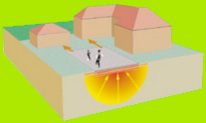
Heating and cooling loads in Hospitals
Hospitals have specific heating and cooling requirements – unlike offices they are occupied day and night, every day of the year. There is a large need for hot water for washing, hygiene and kitchen facilities. Hospitals are often heated to higher temperatures than other buildings with a higher frequency of air changes. With extensive use of glass in modern hospitals there can be large passive solar gains and this can lead to high cooling loads in summer as well as critical heating loads in winter. Some departments within hospitals generate heat from use of medical equipment and computers systems.
With large heating and cooling needs within modern hospitals there is a large opportunity for energy saving which can be met by careful design to reduce the carbon footprint. Interseasonal Heat Transfer can address these needs efficiently and economically by balancing the manifold needs for heating and cooling within the hospital, and between seasons.
There are also large heating and cooling needs in existing hospital buildings. Where there are large heating bills there are often opportunities to save energy by employing Interseasonal Heat Transfer to recycle heat from summer to winter and to integrate with existing heat distribution systems. Every building is different: please contact ICAX if you would like us to assess the potential to save energy, money and carbon on your hospital estate.
The Department of Health has funds for improving energy efficiency in the NHS. The 2013/14 £50m fund is for "new and innovative projects to improve energy efficiency and reduce the carbon footprint of the NHS by reducing energy usage, carbon emissions and improving resilience to climate change".
Heat Sharing Networks within Hospitals – Decarbonising Heat
There can be good reasons to install a heat sharing district circuit within a hospital estate. This communal circuit, which is linked to a communal ThermalBank, can be accessed by each building on the circuit to extract heat via a heat pump when it needs heat and to reject heat when the building needs cooling. See Heat Sharing Networks.
Robust Hospitals Film
A Cambridge University research project to test refurbishment strategies for improving energy efficiency and resilience of NHS hospital buildings has released key findings in its Robust Hospitals film.
The NHS generates some 18 millions tons of carbon and CO2 a year, around 30% of public sector emissions, of which 22% comprises energy used to light, heat and cool its buildings. Stringent targets have been set for energy reduction, with a 15% efficiency saving required of the NHS between March 2000 and March 2015. The Government is committed to reducing CO2 emissions by 26% below 1990 levels by 2020, and by 60% below 1990 levels by 2050.
The Design and Delivery of Robust Hospital Environments in a Changing Climate project, led by Professor Alan Short of Cambridge University Architecture Department, investigated practical strategies for the adaptation of the NHS Retained Estate to increase its resilience to climate change whilst meeting the onerous emissions targets. Funded by the Engineering and Physical Sciences Research Council and the Department of Health, the research team examined resilience to summertime overheating of NHS hospital buildings, and devised and tested refurbishment strategies for a sample of hospital buildings.
See the revealing 30 minute Robust Hospitals film.
Energy Saving by Recycling Summer Heat to Winter Warmth
Saving energy begins with constructing well insulated buildings and continues with finding the most economic form of Renewable Energy to create Low Carbon Buildings.
Interseasonal Heat Transfer™ for low carbon hospitals ...
- provides reliable, low-cost on site Renewable Heat for space heating by re-cycling solar energy
- saves over 60% of carbon emissions compared to using a gas boiler for heating
- provides reliable, low-cost, on site Renewable Cooling by re-cycling winter cold
- saves over 80% of carbon emissions compared to using standard air conditioning for cooling
- provides low-cost heat source for processes using ThermalBanks as thermal stores
- reduces emissions by using re-cycled solar energy instead of burning fossil fuels
- prolongs the life of solar thermal panels by saving the heat in ThermalBanks instead of allowing them to overheat in summer
- attracts Renewable Heat Incentive cashback for use of ground source heat pumps
- attracts Renewable Heat Incentive cashback for use of solar thermal collectors
... the most attractive choice for those who aim to construct Low Carbon Hospitals
The combined benefits make IHT the most attractive renewable energy choice for offices, schools and universities, hospitals, community centres, urban and suburban housing developments, industrial developments and private houses aiming for low energy buildings.
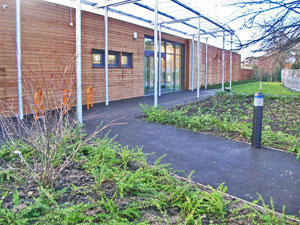
Merton Intergenerational Centre heated in winter, cooled in summer, by IHT
Low Carbon Buildings
Interseasonal Heat Transfer is the key to sustainable building by providing solar space heating and natural cooling through one integrated design.
See Ground Source Energy | Ground source heating and cooling
IHT for Offices | IHT for Schools | IHT for Retail | IHT for Houses | Renewable Heat
ICAX Projects:
Toddington | Howe Dell | Hiroshima | HMP Garth | Suffolk One | Merton | Wellington | Greenfield Supermarket | UTP Factory | Cambridge Terrace
