

Renewable Heat Incentive – RHI Commercial
Owners of ground source heating installations in non-domestic buildings can receive a cashback subsidy, based on the metered heat use of a building (from the date that the building is accredited with Ofgem), of 9.68 pence per kilowatt hour used – for the first twenty years of use.
RHI Table of Tariffs – RHI Commercial – paid over 20 years
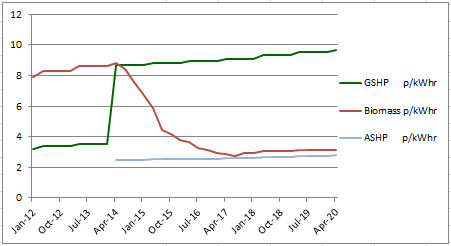
The RHI tariff table below shows the technologies eligible for RHI, the subsidy to be received over the first twenty years. The RHI now provides a major incentive for owners to invest in ground source heat pumps, solar thermal and other renewable heat technologies. The tariffs are based on pence/kWh of renewable heat delivered and vary with the technology and scale used. The tariffs for standard renewable technologies are:
| RHI Commercial paid over 20 years |
p/kWh from 1 Jan 2015 |
p/kWh from 1 Apr 2015 |
p/kWh from 1 Jul 2015 |
p/kWh from 1 Oct 2015 |
p/kWh from 1 Jan 2016 |
p/kWh from 1 Apr 2016 |
p/kWh from 1 Jul 2016 |
p/kWh from 1 Oct 2016 |
p/kWh from 1 Jan 2017 |
p/kWh from 1 Apr 2017 |
p/kWh from 1 Jul 2017 |
p/kWh from 1 Oct 2017 |
p/kWh from 1 Apr 2018 |
p/kWh from 1 Apr 2019 |
p/kWh from 1 Apr 2020 |
| Solar thermal | 10.0 | 10.16 | 10.16 | 10.16 | 10.16 | 10.28 | 10.28 | 10.28 | 10.28 | 10.44 | 10.44 | 10.44 | 10.75 | 10.98 | 11.12 |
| GSHPs | 8.7 | 8.84 | 8.84 | 8.84 | 8.84 | 8.95 | 8.95 | 8.95 | 8.95 | 9.09 | 9.09 | 9.09 | 9.36 | 9.56 | 9.68 |
| ASHPs | 2.5 | 2.54 | 2.54 | 2.54 | 2.54 | 2.57 | 2.57 | 2.57 | 2.57 | 2.61 | 2.61 | 2.61 | 2.69 | 2.75 | 2.78 |
| Biomass¹ | 6.8¹ | 5.87¹ | 4.40¹ | 4.18¹ | 3.76¹ | 3.62¹ | 3.26¹ | 3.10¹ | 2.91¹ | 2.85¹ | 2.71¹ | 2.96¹ | 3.05¹ | 3.11¹ | 3.15¹ |
RHI rates published by Ofgem – rates change with inflation each year from April.
RHI rates for ground source heat pumps fall to 2.89p for use over 15% of the full rated annual capacity.
RHI rates for ground source heat pumps above 100kW capacity is reduced to 8.72p from April 2020, and 6.98p from July 2020.
¹ RHI rates for biomass fall to 2.21p for use over 35% of the full rated annual capacity.
¹ RHI tariff for biomass has fallen from 8.8 in June 2014 down to 3.15p from 1 April 2020.
There are also specialist commercial RHI tariffs for additional renewable technologies:
| RHI Commercial paid over 20 years |
Scale | p/kWh from 1 Jan 2015 |
p/kWh from 1 Apr 2015 |
p/kWh from 1 Jul 2015 |
p/kWh from 1 Oct 2015 |
p/kWh from 1 Jan 2016 |
p/kWh from 1 Apr 2016 |
p/kWh from 1 Jul 2016 |
p/kWh from 1 Oct 2016 |
p/kWh from 1 Jan 2017 |
p/kWh from 1 Apr 2017 |
p/kWh from 1 Jul 2017 |
p/kWh from 1 Apr 2018 |
| Solid Biomass CHP | 4.1 | 4.17 | 4.17 | 4.17 | 4.17 | 4.22 | 4.22 | 4.22 | 4.22 | 4.29 | 4.29 | 4.42 | |
| Biogas small | <200kW | 7.5 | 7.62 | 7.62 | 7.62 | 7.62 | 6.94 | 5.90 | 4.43 | 3.32 | 3.20 | 2.88 | 2.97 |
| Biogas medium | 200-600 | 5.9 | 5.99 | 5.99 | 5.99 | 5.99 | 5.45 | 4.63 | 3.47 | 2.60 | 2.51 | 2.26 | 2.33 |
| Biogas large | >600kW | 2.2 | 2.24 | 2.24 | 2.24 | 2.24 | 2.04 | 1.73 | 1.30 | 0.98 | 0.95 | 0.86 | 0.89 |
| Deep Geothermal | 5.0 | 5.08 | 5.08 | 5.08 | 5.08 | 5.14 | 5.14 | 5.14 | 5.14 | 5.22 | 5.22 | 5.38 | |
| Biomethane | tier 1 | 6.8 | 7.62 | 7.24 | 6.52 | 5.87 | 5.35 | 4.55 | 4.43 | 3.89 | 3.56 | 3.20 | 3.30 |
| Biomethane | tier 2 | 6.8 | 4.47 | 4.25 | 3.83 | 3.45 | 3.14 | 2.67 | 2.54 | 2.29 | 2.10 | 1.89 | 1.95 |
| Biomethane | tier 3 | 6.8 | 3.45 | 3.28 | 2.95 | 2.66 | 2.42 | 2.06 | 1.96 | 1.76 | 1.61 | 1.45 | 1.49 |
RHI Background
Renewable Heat is a subset of the wider category of renewable energy, which includes the generation of electricity from wind turbines and photovoltaic cells.
According to BERR (the new name for the DTI), almost half of the final energy consumed in the UK is in the form of heat. Its generation accounts for 47% of UK CO2 emissions. Renewable Heat currently satisfies less than 1% of heat demand.
DECC (the new name for part of BERR) is encouraging Renewable Heat as part of the Government's commitment to aim for 15% renewables by 2020 and is introducing the Renewable Heat Incentive.
BEIS (the new name for part of DECC) has confirmed that the RHI will continue to be available for systems installed and commissioned by 31 March 2021.
For the Renewable Heat technologies included, the energy ultimately comes from the sun. The sun provides planet earth with more energy each hour than human civilization uses over a whole year. The challenge is how to make use of this vast supply of incoming radiation to provide solar space heating and hot water.
The DECC press release of 10 March 2011 said: The Renewable Heat Incentive (RHI) will support emerging technologies and businesses in the UK, strengthening security of supply by reducing dependence on fossil fuel heating and emissions.
* Currently around half of the UK's carbon emissions come from the energy used to produce heat – more than from generating electricity. The RHI will reduce emissions by 44 million tonnes of carbon to 2020, equivalent to the annual carbon emitted by 20 typical new gas power stations.
* over 95% of heat in the UK is currently produced by burning fossil fuel but with North Sea supplies now in decline leading to an increase in imports, low carbon alternatives are needed.
* The new financial incentive will encourage installation of equipment like renewable heat pumps, biomass boilers and solar thermal panels to reduce emissions and support the existing 150,000 jobs in the heating industry.

The purpose of the Renewable Heat Incentive Scheme
The aim of the RHI is to increase heat generation from renewable energy to 12%. This could save up to 60 million tonnes of CO2 by 2020. Heating currently accounts for 47% of the UK’s CO2 emissions and 60% of average domestic energy bills.
The UK has one of the lowest contributions from renewable heat of all EU countries. Sweden produces half of its heat from renewables and the EU average is over 10%.
The Renewable Heat Incentive has received strong backing from MPs from all political parties, including Caroline Lucas, Zac Goldsmith and Alan Whitehead.
Comment on the Renewable Heat Incentive
From the DECC website: To meet our 2020 15% renewable energy target, we need to develop new ways of generating renewable energy in all sectors, including heat. Heat generated from renewable sources accounts for approximately 1% of total heat demand – this may need to rise to 12% to hit our binding EU targets. We will not be able to expand renewable heat without some form of financial assistance because other forms of heat are currently cheaper. Such support will enable more people to afford renewable heat and, by expanding the market, help bring costs down more quickly.
An investment in renewable energy usually means payment of a higher capital cost to achieve lower annual running costs (and also a lower carbon emission for the benefit for the community at large). The RHI will reduce the annual running cost of Interseasonal Heat Transfer to a very low level and allow owners to reduce the payback period from their investment to a few years.
Owners of IHT installations will benefit from the RHI for using ground source heat pumps and the RHI for using Solar Thermal when IHT is used to provide domestic hot water.

The RHI is calculated to offer a good return on initial investment
The introduction of the RHI offers a financial reward for lower carbon emissions over the twenty year life of the renewable heating technology installed. The tariffs for the Renewable Heat Incentive have been calculated to offer a rate of return of 12% on the initial investment across the tariff bands.
The introduction of the RHI coincides with a time of increasing wealth and demand for fossil fuels from an increasing world population: many pundits expect the price of oil and gas to increase much more sharply than general inflation over the next three years.
While there are a number of renewable energy options to be considered, ICAX believes the most practical and affordable answer to generating Renewable Heat is to use Interseasonal Heat Transfer.
The RHI provides a positive step change in the business case for delivering on-site renewable heat, not only to reduce energy bills and carbon emissions, but also to deliver a energy related cash flow into your building.
Tony Grayling, head of Climate Change and Sustainable Development at the Environment Agency said: Ground source heating is a rapidly growing technology that has the potential to produce at least 30% of the country’s renewable heat needs, but it needs support in order to grow. We would like to see this technology given adequate financial support through the new renewable heat incentive to meet its full potential in the UK.
RHI Administration by Ofgem
The RHI is administered by Ofgem. Owners of renewable heat technologies included apply to Ofgem who pay tariffs, on a quarterly basis, over 20 years. Owners need to provide information on the metered heat generated and satisfy Ofgem that the equipment is used to provide space heating or hot water and that the equipment is maintained according to the manufacturer's instructions. For installations rated up to 45 kW capacity the equipment and the installers will need to be MCS certified, or equivalent.
For the full Renewable Heat Incentive publication (90 pages) of 10 March 2011: Original RHI publication.
For the full Ofgem RHI Guidance Consultation publications (202 pages) of 24 June 2011: Ofgem RHI Volume 1 and Ofgem RHI Volume 2.
Hybrid Renewable Energy Systems
With each renewable energy technology being only marginally economic on its own, the industry is searching to complement the strengths of different renewable technologies into hybrid renewable energy systems. Interseasonal Heat Transfer is an example of a hybrid renewable energy system: IHT combines the merits of solar thermal collection in summer, heat storage in ThermalBanks over the autumn and heat delivery with ground source heat pumps in winter.
RHI Tax free income
RHI tariffs are exempt from income tax. This means that domestic users and other income tax payers will not be taxed on any income received from the Feed-In Tariffs or the Renewable Heat Incentive.
For those using IHT, the annual clean energy cashback for heating will normally be larger than the annual running cost.
See also: Banking on IHT The Merton Rule Ground Source Energy Economic Renewable Energy
