



Renewable Cooling – Green Cooling – Process Cooling
Renewable Cooling is the provision of cooling to buildings by using natural, renewable resources, instead of consuming fossil fuels. The standard solution for providing cooling to buildings is to use chillers and air conditioning which uses a very large amount of electricity: this is expensive and (if the electricity comes from a power station which is powered by gas, oil or coal) will cause the release of large quantities of CO2 into the atmosphere.
The basis of chillers is to use heat pumps to "waste" heat from a building to the outside atmosphere. As cooling is only required when it is already too hot outside the heat pump has a lot of work to do to achieve its objective and this consumes a lot of electricity. This process is inefficient and wasteful: a 2017 BRE report to BEIS, "Study on Energy Use by Air Conditioning", has estimated that 10% of all UK electricity consumption is used to provide cooling.
Ground Source Cooling
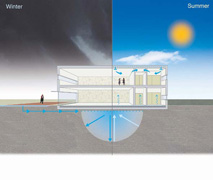
There is a better way to achieve cooling in buildings. This is a further exciting manifestation of Interseasonal Heat Transfer™. Having installed IHT™ in a new building to provide Renewable Heat in winter all the mechanism is in place for the IHT system to work in reverse and provide Renewable Cooling in summer, at a fraction of the cost of using air conditioning and chillers to provide cooling.
The effective use of Renewable Cooling requires three keys steps:
- Capture of cold temperatures
- Storage of cold temperatures
- Release of cooling
Capture of Renewable Cooling
While an ICAX Asphalt Solar Collector is designed to capture heat on hot summer days, it is also equally capable of capturing cold temperatures, or "coolth", on cold winter nights. The asphalt is used to reject heat to the night air – which is especially effective on winter nights. [An interesting by-product of taking cold from the Collector is the health-and-safety advantage of inhibiting the surface from freezing].
Storage of Renewable Cooling
Storage of cold for an extended period has been problematic until the recent breakthrough by ICAX which has, after an extensive period of studying the movement of temperature in the ground, designed and patented Thermal Banks.
ThermalBanks are very large thermal stores, normally constructed beneath the foundation of new buildings. They are designed to store a large amount of warmth – or cold – over a period of months, between seasons. This breakthrough allows cold temperatures to be freely stored in winter, when it is abundant, until the time that it is needed for space cooling in summer. ICAX asphalt collectors are used to lower the temperature of a Thermal Bank in the ground from its natural temperature of 10°C down to 1°C over the course of the winter.
Release of Renewable Cooling
There are no serious technical problems in the release of cold from a cold thermal bank into a building if the building is already equipped with the underfloor circulation pipes that are used to distribute heating in winter. (There would be issues of circulating water at below the dew point to underfloor piping, but these can be resolved by the ICAX control systems for IHT).
Free Cooling
There are, in practice, two ways of providing cooling using IHT. The first is to use “heat dumping” which uses a minimal amount of electricity to circulate cold water from the ThermalBank into the building using the underfloor piping. This is a very efficient mechanism for providing "critical period cooling" at very low cost. This is also known as "free cooling". The Coefficient of Performance ("CoP") of free cooling can be as high as 40; the equivalent CoP of using chillers for cooling on a hot day can be as low as 1.5.
Comfort cooling does not need to be expensive
Where cooling demands are larger than can be met by free cooling, IHT can also use heat pumps in reverse to transfer heat more aggressively from the building down to the cold ThermalBank. This is also inexpensive compared to using chillers, as the heat pump starts with cold water from the ThermalBank instead of warm air from outside.
In search of balance using Ground Source Cooling
IHT can help you achieve a heat balance within a building: IHT can extract heat from fileserver rooms and those suffering from solar gain and distribute it to shaded rooms needing heat. This saves on heating cost for cold rooms and cooling cost of hot rooms. When there is an overall cooling requirement IHT will save the excess heat from the building in a ThermalBank – and recycle that heat back to the building in winter. For buildings with an overall annual cooling requirement, ICAX uses heat rejection techniques (at night time and in winter) to dissipate surplus heat.
Ground Source Heating and Cooling
Ground Source Heating and Cooling ("GSHC") is the term used to describe a single integrated system that performs both functions – heating and cooling – using the same equipment linked to ground source energy.
A critical component of a successful GSHC installation is to have the control philosophy embedded into the heart of the system. In an ICAX IHT system this allows for simultaneous heating in one part of a building (such as north facing low-activity room) and cooling in another (IT server rooms). This technique results in the cheapest form of heating and the cheapest form of cooling – both in cash terms and in CO2 emissions.
Integration and Harmony
IHT is a straightforward ground source heating and cooling system that is designed to balance the heating and cooling requirement of a building over the course of the seasons. This is in contrast to the traditional approach of throwing money and fossil fuels indiscriminately at both extremes of the year, as if they were separate problems that had to be addressed by separate budgets and separate mechanisms.
Renewable Cooling is used on the following ICAX Projects
Merton Intergenerational Community Centre
| Tesco Greenfield Superstore
| UTP Factory
| Cambridge Terrace
See also: Renewable Heating
See also: Banking on IHT™
See also: article on Natural Cooling
See also: District Cooling Networks
See also: Ground source heating and cooling
