
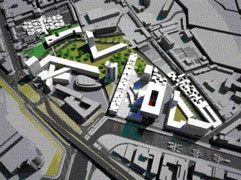
Energy Hub
Energy-Hub for residential and commercial districts and transport
E-Hub is a collaborative €11.66 million European project, part funded by the EU, which aims to demonstrate the full potential of renewable energy by providing 100% on-site renewable energy within an "Energy Hub District". ICAX has been invited to join the collaborative project for its expertise in pavement solar thermal collectors.

An Energy Hub is a physical cross point, similar to an energy station, in which energy and information streams are coordinated across a local Smart Grid, and where different forms of energy (heat, electricity, chemical, biological) are converted between each other or stored for later use.
The Energy Hub exchanges energy via the smart energy grids between its members (households, renewable energy plants, offices), who may be both consumers and suppliers. The members exchange information on their energy production and energy needs with the Energy Hub. The Hub then distributes the available energy in the most efficient way.
To match supply and demand, the Energy Hub converts and stores energy and performs load shifting. The members will be connected to the Energy Hub by means of bi-directional energy grids (low and high temperature heat grids, electrical grids (AC and DC) and gas grids (hydrogen, biogas, syngas).
Renewable energy may be generated by individual members (e.g. from PV on residences) or by central means (a ground source energy or a large combined heat and power plant) located within the district that may be fueled by solar energy, biofuel or hydrogen.
The Energy Hub brochure illustrates the ideas that have been studied in the E-Hub project.
District Heating and Cooling from On-Site Renewable Energy
The Energy Hub idea covers all types of energy flow, from heating and cooling to electricity, biogas and hydrogen, and may be connected not only to households but also to (electric) cars, commercial buildings and industry.
The aim of the project is to develop the Energy Hub as a system, to develop technologies that are needed to achieve the system successfully, to develop business models in order to overcome institutional and financial barriers, and to demonstrate a live Energy Hub with further feasibility studies to extend the principle.
ICAX joins a distinguished group of companies from across the European Union researching into a successful Energy Hub District, led by TNO of the Netherlands.
| Role | |||
| TNO | Nederlandse Organisatie voor Toegepast natuurwetenschappelijk Onderzoek | The Netherlands | Project Manager |
| ECN | Energy Research Centre of the Netherlands | The Netherlands | Techniques development |
| D'Appolonia | D'Appolonia SPA | Italy | System definition |
| Finlombarda | FinLombarda SPA | Italy | Feasibility studies |
| Acciona | Acciona Infraestructuras s.a. | Spain | Energy conversion and storage |
| Solintel | Solintel M & P SL | Spain | Techniques development |
| ICAX | ICAX Ltd | UK | Pavement solar collectors |
| HSW | H.S.W. Ingenieurbuero fuer Angewandte und Umweltgeologie GmbH | Germany | Thermal foundations |
| Mostostal | Mostostal Warszawa SA | Poland | Thermoactive foundations |
| VITO | Vlaamse Instelling voor Technologisch Onderzoek | Belgium | Energy management systems |
| Fraunhofer | Fraunhofergesellschaft zur Foerderung der Angewandten Forschung E.V. | Germany | Energy management systems |
| TPG | TPG / University of Genoa | Italy | Integrated energy networks |
| Ertzberg | Ertzberg CVBA | Belgium | Demonstration at Tweewaters |
| VTT | Valtion Teknillinen Tutkimuskeskus | Finland | Business strategies |
| ISPE | Intesa Sanpaolo Eurodesk S.P.R.L | Belgium | Business strategies |
| EDF | Electricite de France | France | Energy advisory |
Renewable Energy Systems - Wide ranging research project
The research group is exploring many ideas to achieve its aims of local generation and sharing of energy, including:
Energy capture:
Carbon FRP composites
thermo active foundations - energy piles
thermal road solar collector systems
Quartzite aggregates
Energy generation and conversion:
CHP - combined heat and power
distributed generation of electricity and heat
generation within the built environment
electrolysis for the production of hydrogen
Energy storage:
Energy storage including electricity storage and heat storage
thermochemical seasonal thermal storage
borehole thermal energy storage
solid salt hydrates
Energy balance is the ideal form of heating and cooling
balanced seasonal operation of heating and cooling
Chemical sorption storage
The effectiveness of CHP is only feasible in combination with thermal energy storage
development of advanced compact thermal energy storage
Energy delivery:
exchange of energy within buildings
Energy balancing:
fluctuating character of supply
demand control by load shifting
Energy control:
"PowerMatcher" coordinates supply and demand of electricity within networks
"Intelligator" coordinates supply and demand of heat and electricity wthin district networks
District energy management system
bi-directional energy grids
matching energy demand with supply
matching energy supply with demand
smart energy networks - smart grids
district energy management system
See Energy Hub website.
See Ground Source Heating See Ground Source Cooling See Ground Source Energy
